Becoming tlbx: Action Graphs, Software Supply-Chain Integrity, and Kitty Graphics
Completing the identity migration from MidTerm to tlbx 10, introducing agent-curated boards with optimistic revisions, and shipping signed SPDX SBOMs with GitHub attestations.
By July 2026, the project had outgrown its original name "MidTerm." It had started as a web terminal multiplexer, yet day-to-day usage spanned persistent terminals, structured agent controllers, embedded Dev Browser verification, Git review, and multi-session coordination.
Across 250 focused commits from July 16 to August 11, 2026 (v10.0.0 through v10.6.15), we shipped the tlbx 10 identity, introduced Action Graphs (persistent zoomable workspace boards), and turned release integrity into an auditable, fail-closed pipeline.
Migrating an Installed Base Without Breaking Existing Hosts
Renaming a self-hosted service touches every operational surface: install directories, Windows Service display names, firewall rules, TLS certificates, update manifests, and npm package coordinates.
In v10.0.0 (tlbx 10 — identity complete), we split fresh identity from upgrade compatibility cleanly:
- Fresh installations use
tlbxconsistently across visible chrome, config/log paths, service identity, and newly generated certificates, while canonical discovery moved totlbx.aiandget.tlbx.ai. - Existing MidTerm installations remain updateable in place: the runtime and updater discover both layouts during migration, wire/binary compatibility (
mt,mthost,mtagenthost,@tlbx-ai/midterm) remains intact, andmidterm.tlbx.airedirects public documents cleanly to matchingtlbx.airoutes.
Action Graphs: Separating Agent Semantics from State Enforcement
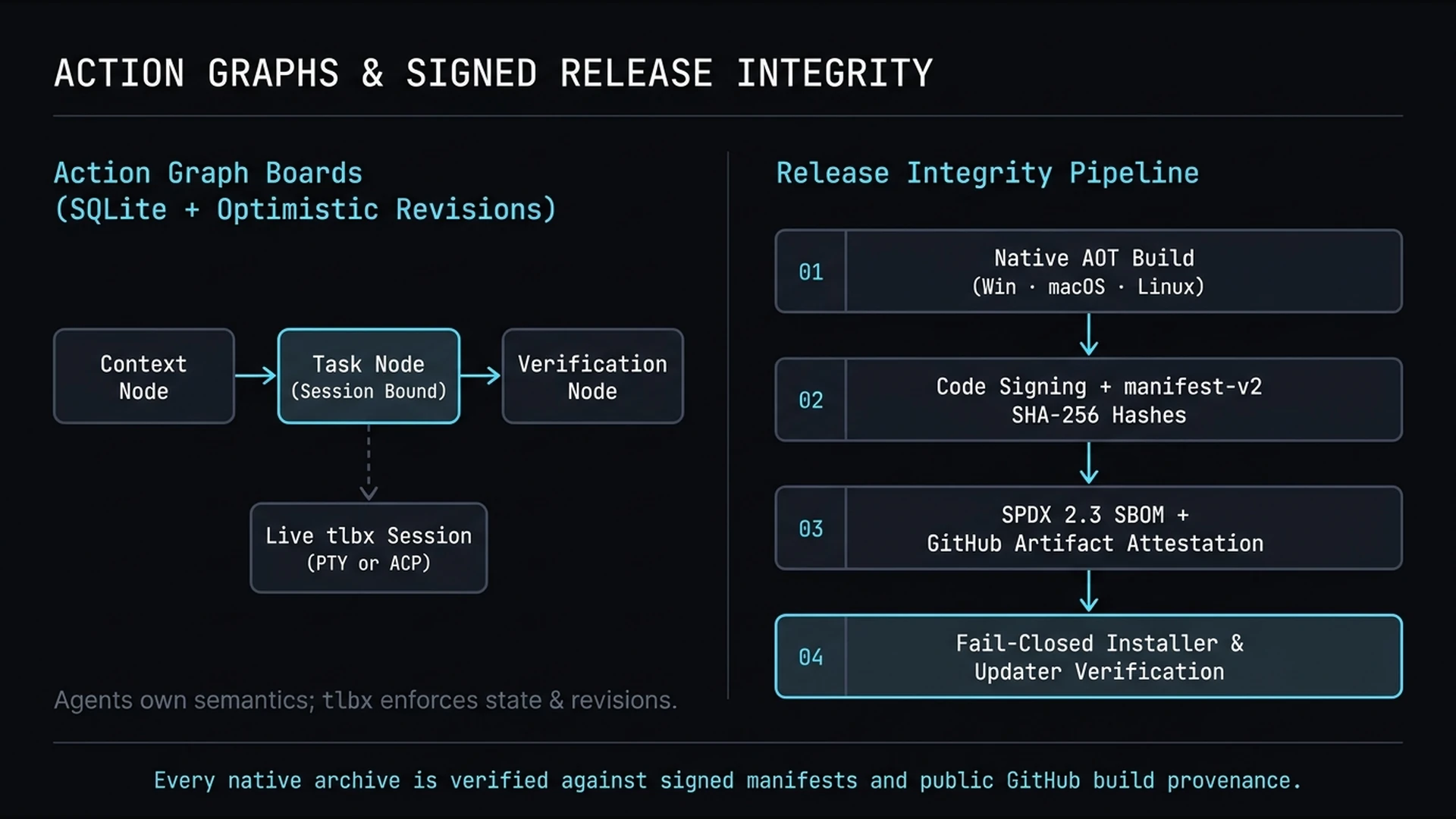
When a larger engineering task splits across research notes, parallel coding sessions, and verification steps, a flat sidebar list loses the structure of the work. In v10.1.0-dev and v10.2.0-dev, we introduced Action Graphs (later surfaced as Boards): a SQLite-backed zoomable canvas with WYSIWYG editing, explicit scopes, and optimistic concurrency revisions.
Two invariants governed the design from day one:
- Every executable item runs behind a real tlbx session. Boards never invent a hidden execution runtime outside observable PTY or Agent Controller sessions.
- Agents own meaning; tlbx enforces exact state. Agents decide how nodes relate, which items need attention, and how to decompose work. tlbx remains deliberately oblivious to domain semantics—it owns exact node/edge identities, optimistic revision tokens, multi-session bindings, and authenticated mutations.
Software Supply-Chain Hardening (v10.4–v10.6)
Self-hosted developer tools run with the permissions of the engineer's workstation. Trusting a release archive should rely on cryptographic evidence, not on optimism.
Between v10.4.0 and v10.6.4, we hardened the release and verification pipeline across all six native targets (win-x64, win-x86, osx-arm64, osx-x64, linux-x64, linux-arm64):
| Verification Layer | Artifact / Mechanism | What It Proves |
|---|---|---|
| GitHub Build Provenance | gh attestation verify mt-win-x64.zip --repo tlbx-ai/tlbx |
Archive digest was built by the official tlbx-ai/tlbx GitHub Actions release workflow |
| SPDX 2.3 SBOM | Platform-specific .spdx.json paired with every archive |
Public dependency transparency snapshot with verifiable attestation |
Signed manifest-v2 |
Verified inside installers and the built-in updater | Binds web/PTY/protocol versions, platform, update channel, and SHA-256 hashes of every packaged file |
| Fail-Closed Extraction | Re-hashing every extracted file before swap | Any missing file, unlisted file, signature error, or hash mismatch aborts the install/update |
In v10.6.15 (August 11, 2026), we also completed the licensed Windows Kitty runtime integration alongside the refreshed xterm rendering stack (v10.3.0), enabling native inline terminal graphics without breaking standard TERM=xterm-256color behavior.
Milestone Summary
- Commits in phase: 250 (
2026-06-20to2026-08-15) - Key tags:
v10.0.0,v10.2.0-dev,v10.6.2,v10.6.15 - Durable result: Unified
tlbxproduct identity, SQLite-backed Action Graphs, fail-closedmanifest-v2+ SPDX + GitHub attestation verification, and native Kitty terminal graphics. Review the public verification commands on/securityor read the ADE guide.