.NET 11 Native AOT, Fixing WebRTC Head-of-Line Blocking, and Cross-Provider ACP Handoff
Upgrading every platform to .NET 11, cutting keystroke echo latency from 3,398 ms to 742 ms under simulated cellular load, and handing context cleanly between Codex, Claude, and Antigravity.
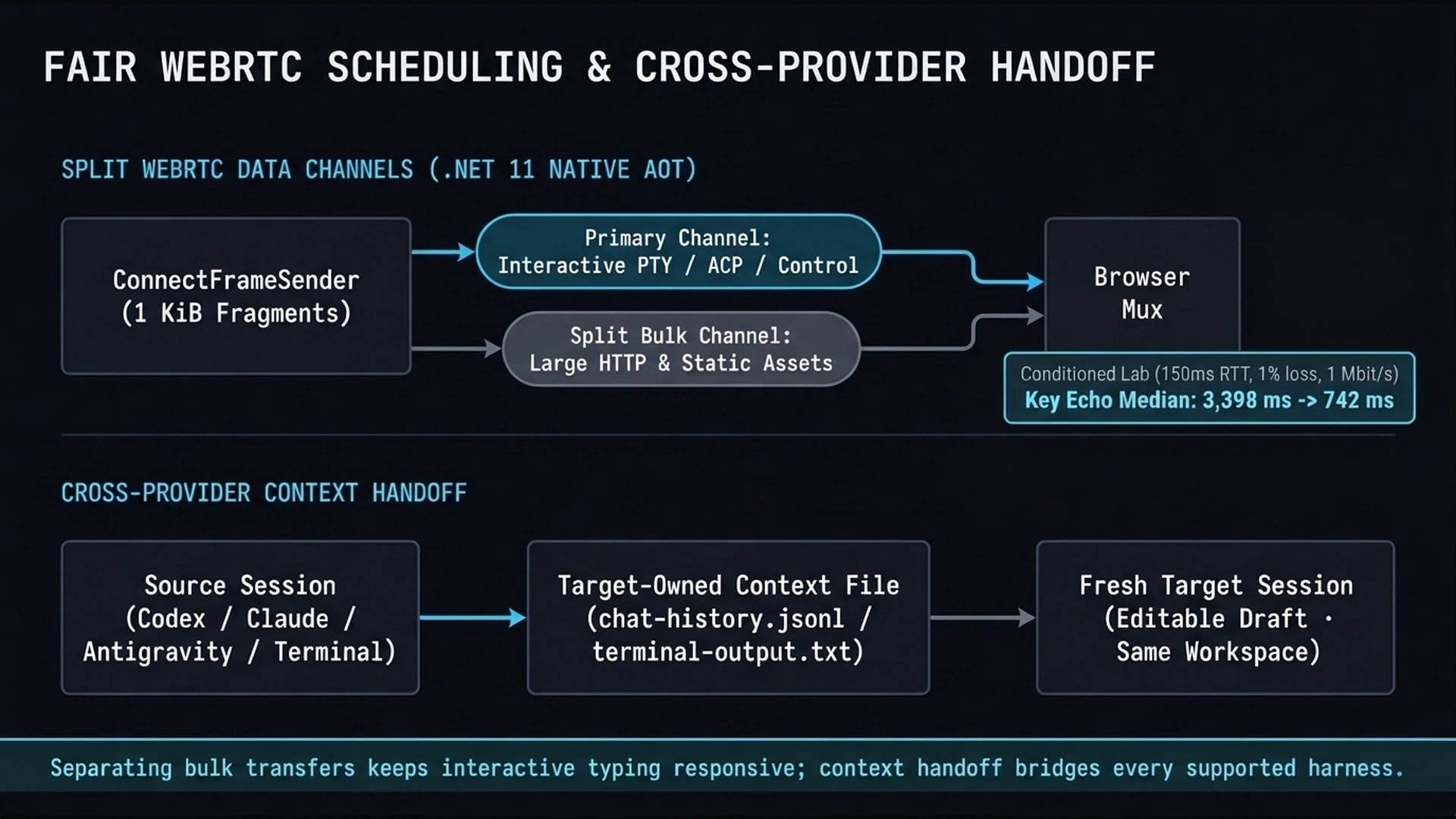
November 2026 was the highest-velocity engineering stretch since February: 768 commits across v11.0.0 through v11.4.13-dev. Three independent pressures drove the work—upgrading the entire runtime stack to .NET 11 Native AOT, proving interactive responsiveness over real lossy cellular WebRTC links, and letting developers move seamlessly between coding-agent harnesses without losing context.
.NET 11 Native AOT & Native tlbx MCP (v11.0–v11.2)
On November 10, 2026 (v11.0.0), every binary in tlbx—mt, mthost, and mtagenthost—moved to .NET 11 with Native AOT and Runtime Async (runtime-async=on) across Windows x64/x86, Linux x64/ARM64, and macOS ARM64 (plus on-demand macOS Intel).
Right after v11.0.0, we promoted native tlbx MCP (mt mcp --stdio and POST /api/mcp) to the primary automation interface (v11.1.6, v11.1.8, v11.2.0):
- Compact session and repository summaries by default, with
tool_call_to_fileredirecting oversized terminal buffers or Git snapshots directly to caller-local files without flooding model context. - Binary
ACH1history framing over the independent host IPC read lane (history.window.read) decoded in a dedicated browser worker, keeping long ACP conversations fast to open and scroll. - Distinct MCP tool call rows, historical file review, and actual changed-file extraction derived strictly from recorded patch headers rather than inline prose mentions (
v11.2.2–v11.2.4).
Reproducing—and Fixing—WebRTC Head-of-Line Blocking (v11.2.6–v11.3.18)
Real mobile usage over cellular networks exposed a painful failure mode in tlbx Link: whenever a large static asset or 2+ MB JSON Git payload was in flight over the single ordered WebRTC DataChannel, typing into an active terminal stalled for tens of seconds.
Rather than guessing, we built a reproducible local Link lab with real Chrome, an isolated coturn container, and Linux tc netem network conditioning (150 ± 40 ms RTT, 1% packet loss, 1 Mbit/s bandwidth) while transferring a 2.76 MB asset concurrently with live PTY keystrokes—measuring the full round-trip from browser keydown through host PTY echo back to browser mux receipt.
| Stage & Version | Transport Architecture | Conditioned Key Echo During Bulk Transfer |
|---|---|---|
Baseline (v11.2.6) |
Single ordered DataChannel, 48 KiB whole-envelope writes | 47.7 s stall followed by UI reconnect and next-input timeout |
Fair Sender (v11.3.0-dev) |
ConnectFrameSender with 1 KiB fragments, 8-message interactive priority burst, 8 KiB pending cap, 64 KiB SCTP buffer |
3.0 – 5.1 s (13/13 inputs returned, zero reconnects) |
Split Bulk Channel (v11.3.18-dev) |
Negotiated secondary ordered DataChannel for large HTTP replies; PTY/ACP/control stay on primary channel | Median 3,398 ms → 742 ms; worst case 3,685 ms → 1,230 ms (same ~50.5 s bulk transfer time) |
The lesson was unambiguous: fragment scheduling removes total starvation, and separating bulk HTTP payloads onto their own DataChannel cuts interactive typing latency by more than 4x under lossy mobile conditions—while keeping automatic fallback to the primary channel for older hosts.
Google Antigravity ACP & Cross-Provider Context Handoff (v11.3.19–v11.4.13)
In real engineering work, no single model or agent harness wins every task. You might explore a codebase in Codex, switch to Claude Code for a subtle refactor, or bring in Google Antigravity (agy acp, integrated in v11.3.19-dev)—or jump from an interactive CLI terminal straight into a structured Agent Controller session.
Between v11.4.0-dev and v11.4.13-dev, we built cross-provider context handoff directly into the workspace:
- One-click handoff across all six ACP directions plus Terminal → ACP: Triggered from the session menu, terminal sidebar hover actions, or the local
/handoffcommand. - File-backed, reviewable context (
v11.4.2–v11.4.3): Instead of stuffing truncated text into a giant prompt box, tlbx writes a target-session-ownedchat-history.jsonl(newest-first canonical chat, plan, and tool rows) or full retainedterminal-output.txtscrollback attachment and opens an editable draft in the fresh target session inside the same workspace. - Confirmed settings across restarts (
v11.4.7–v11.4.13): Per-provider model, effort, and permission preferences persist across restarts, live ACP conversation IDs and permission modes survive full runtime updates, and the Stop button interrupts the exact canonical turn independently of WebSocket history state.
Milestone Summary
- Commits in phase: 768 (
2026-11-07to2026-11-22, reaching 5,109 total commits) - Key tags:
v11.0.0,v11.1.8,v11.3.0-dev,v11.3.18-dev,v11.4.0-dev,v11.4.13-dev - Durable result: A .NET 11 Native AOT Agentic Development Environment with measured low-latency WebRTC tunnels and lossless context handoff across Codex, Claude Code, Antigravity, and standard terminals. Explore how tlbx compares on
/t3code-alternativeor read the ADE guide.